Subtitle: A jaded developer’s field guide to surviving the Anxiety Industrial Complex.
Part I: The Noise and the Illusion
Open your feed right now. Go ahead. What do you see?
“Ten minutes to build your autonomous empire!” “If you aren’t using this agent, you’re already obsolete!” “The 24/7 AI worker is here!”
It’s exhausted. The current tech media landscape has devolved into an Anxiety Industrial Complex. They don’t sell solutions anymore; they sell the fear of missing out (FOMO), packaged in slick thumbnails and hyperbolic headlines.
The latest flavor of the month? Clawdbot (or Moltbot, or whatever they rebrand it to next week). The promise is intoxicating: an autonomous agent on a server, doing your job while you sleep. It sounds like magic. It sounds like the future.
But as someone who actually builds things, let me tell you what it smells like: Snake oil. It smells like the desperate sweat of influencers needing content to feed the algorithm beast.

Part II: Ghosts of the Past — Didn’t We Suffer Enough from AutoGPT?
Let’s step back from the cliff edge for a second and remember 2023. Remember AutoGPT?
Oh, the promises! I jumped on that bandwagon too, hoping for a sliver of “autonomous freedom.” But the reality was a joke: we spent hours of effort and hundreds in API credits only for it to complete the most mediocre tasks—like writing a tech news article filled with hallucinations and errors. It couldn’t even handle a simple web scraper without getting stuck in an infinite loop trying to Google “how to Google.”
How is Clawdbot any different?
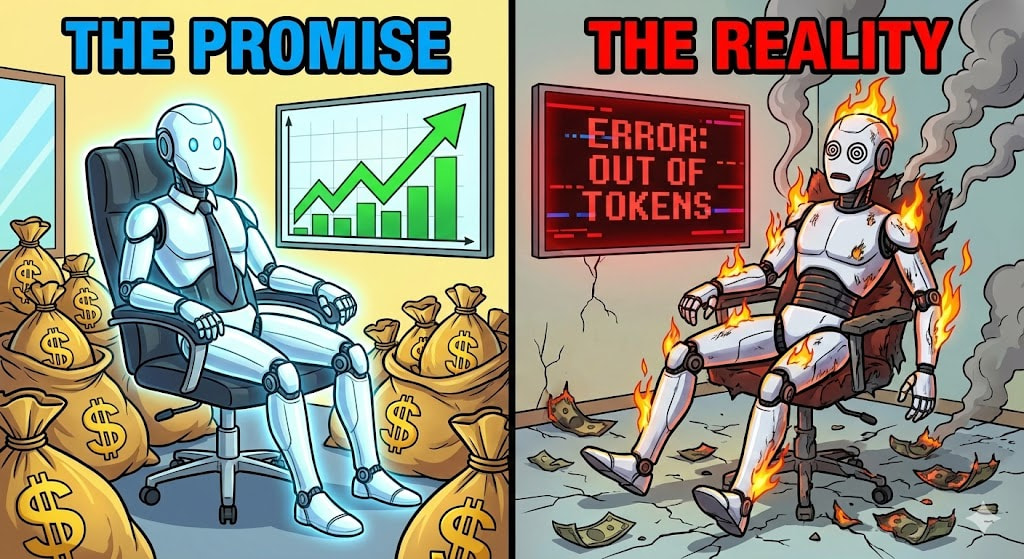
In essence, we are just using a slightly “optimized” AutoGPT, burning through significantly more expensive tokens to perform tasks that are only marginally more advanced. It is still buggy, still unreliable, and still requires constant babysitting. Developers seem to have developed collective amnesia, rebranding the failures of 2023 as the miracles of 2026. Is the massive token consumption really worth it just to modify a line of CSS or log a simple order? It’s an economic absurdity.
Part III: The Hidden Bills — Economy vs. Accuracy
The “AI influencers” love to teach you how to set up your private bot, but no one talks about the actual cost of tokens.
Let’s be real: if tokens were free, people would be using a trillion-parameter model to calculate “1+1” just because they could. There is nothing new about this “limitless” hype. But in the real world, selling people on “autonomous features” while ignoring the price tag is a total con job. It’s intellectually dishonest to talk about the “what” without ever mentioning the “how much.”
And if you try to escape the “Big Tech” token tax by hosting your own open-source models, welcome back to reality:
-
The Hardware Barrier: To achieve the “accuracy” required for high-value production work, you need massive, expensive H100/A100 clusters.
-
The Precision Trap: If you can’t afford the hardware and settle for running low-parameter, highly quantized models (like 7B or 8B versions) on your Oracle server or a home mini-PC, do you really trust them with high-stakes work?
A “cheap brain” that frequently hallucinates and lacks logical depth, paired with “powerful limbs” that have root access to your server, isn’t a productivity tool. It’s a time bomb waiting to go off in your system. True innovation isn’t built on ignoring costs and risks.

Part IV: Don’t Let the Tool Define You
The danger of this clickbait culture isn’t just wasted time; it’s the paralysis it induces. It makes you feel like the actual work you are doing—learning frameworks, understanding databases, iterating on a simple MUD game—is somehow “wrong” or “too slow.”
They want you to believe that if you aren’t using the absolute bleeding-edge, untested alpha tool, you are failing.
Reject that narrative.
Why would I trust a low-precision, high-cost LLM with access to my Oracle server just to change a background color? That’s not innovation; that’s recklessness disguised as efficiency.
If you are building something real—like a WebGL gallery or a text adventure game—stick to the tools that offer stability. Don’t hand the keys to your car to a hallucinating agent and expect it to navigate through rush hour traffic safely.
Conclusion
Build securely. Count your bills. And for god’s sake, stop clicking on those headlines.